
There is something timeless, something grander than the human notion of time, something beyond reach of the comprehension of mere animals in the crushing silence and vast expanse of the desert.
The stillness of everything — rocks, salt, lakes, even grass unmoving in the immobile air — is contagious. It gets at you. It starts with a nudging feeling, poking inside your mind, telling you something is abnormal in the surrounding environment. There is no sound at all, no chirping birds, no rustling leaves, no scurrying rodents. You slow down, and then you stop cycling altogether, as if moving in such a fixed landscape were insulting it.
That moment is the one you begin realizing the immensity, the infinite age, of the place you find yourself in.

Some say the Atacama desert is the gateway to time itself. Between the depths of its inception, measured in geological times rather than puny generations, the indigenous Atacameño people first settling there, and the ultra-modern observatories taking advantage of one of the clearest skies in the world — no surprise, being above the driest desert in the world — the geologists, archaeologists, and cosmologists have a huge playground to explore.
The road takes us through the landscape, lighting up with the sunrise in pastels of blues and yellows. Whites appear after a few kilometers, staining the rocks and bushes, forming a rugged terrain all around us, and annoucing the start of the Atacama salt flat.
We reach the still still Laguna Cejar, a salt lake of course, after a good hour of pedaling in the silence and the emptiness. There we meet our first birds of the morning, at last: flamingoes.


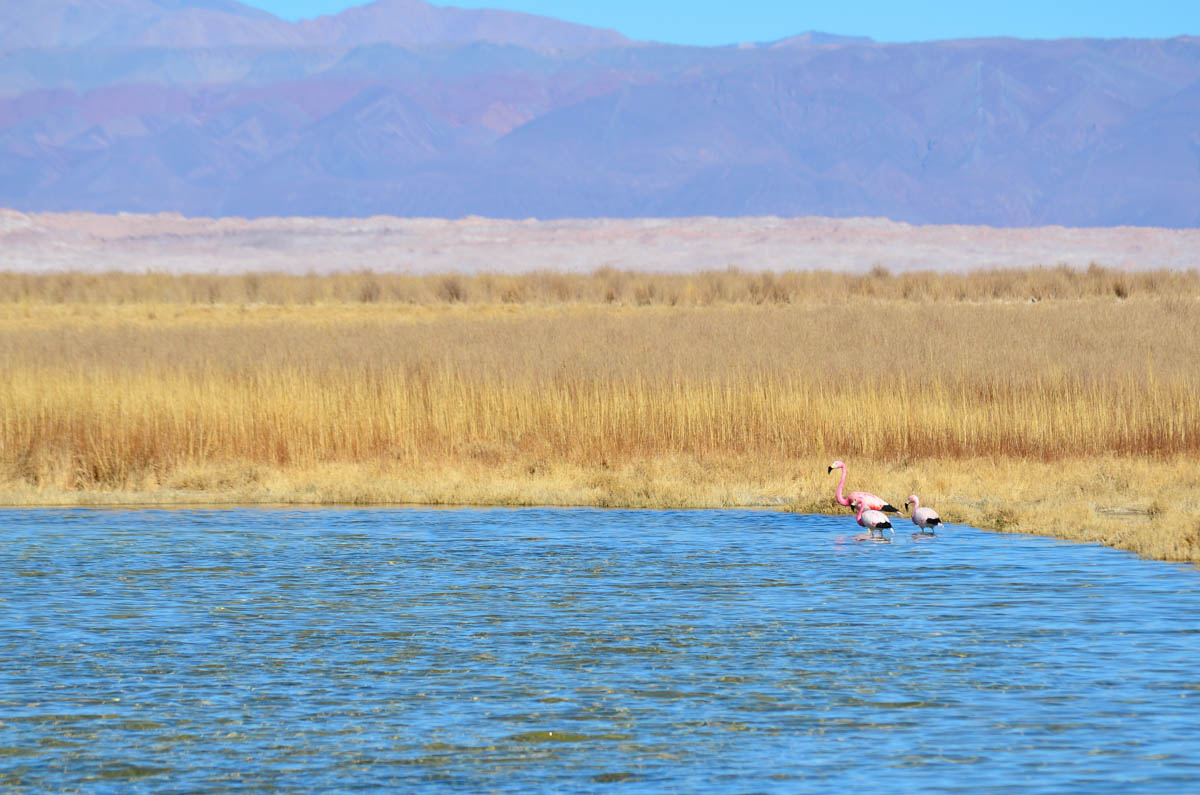


A quick dip in the water reveals us that the area really will not become a beach resort anytime soon. The freezing cold of the night defines the temperature of the lakes, despite the scorching noon sun. The same sun that pounds on us as we make our way to the Valle de la Luna (Moon Valley).
There the rocks create incredible formations in a landscape which seems to come straight out of a postcard from Mars. In the utter silence, quieter than a mountain, quieter than a dive, emerge sometimes the creakings of the pressurized salt crystals as we make our way through canyons and caves, as if they were complaining like us of the intense heat. The ubiquitous sun is merciless.


Sharing a cup of Chilean wine with my friend Patricio afterwards, we cannot but look disbelieving as he tells us it had snowed earlier in the year. He shows us a picture on his phone, and there it is, the most arid desert in the world covered with a very Christmassy blanket of virgin powder snow.
But then again, really, how surprising is it? The Atacama desert never ceases to amaze.