
‘Sometimes I think a man could wander across the disc[world] all his life and not see everything there is to see,’ said Twoflower. ‘And now it seems there are lots of other worlds as well. When I think I might die without seeing a hundredth of all there is to see it makes me feel,’ he paused, then added, ‘well, humble, I suppose. And very angry, of course.’
Terry Pratchett, Close to the Edge
“I had no idea such a place even existed,” I confessed.
I knew we were going to see volcanoes on Java; however, I had pictured myself black, charred craters throwing up scarlet lava at worse, or gigantic plumes of ash and scoria at best. What I had definitely not imagined, though, was desperate men willingly descending in a pit of toxic sulfur gases, right next to an acid lake ready to serve death at any time, to mine molten sulfur with little more than their bare hands.


“They look like convicts,” I added.
“They do,” concurred Guillaume. The others were as aghast as I was.
During our hike up the volcano, we had not yet grasped the sheer harshness of the miners’ work. They had been strolling down the steep path; true, they were laden with their incredibly heavy baskets of sulfur (around 80 kg; we could only lift one up a few millimeters before giving up), but as well smiling and conversing with us, sometimes asking for cigarettes. Their T-shirts “I♥BWI” — Banyuwangi, a nearby city where most of the miners come from — had seemed innocently happy.


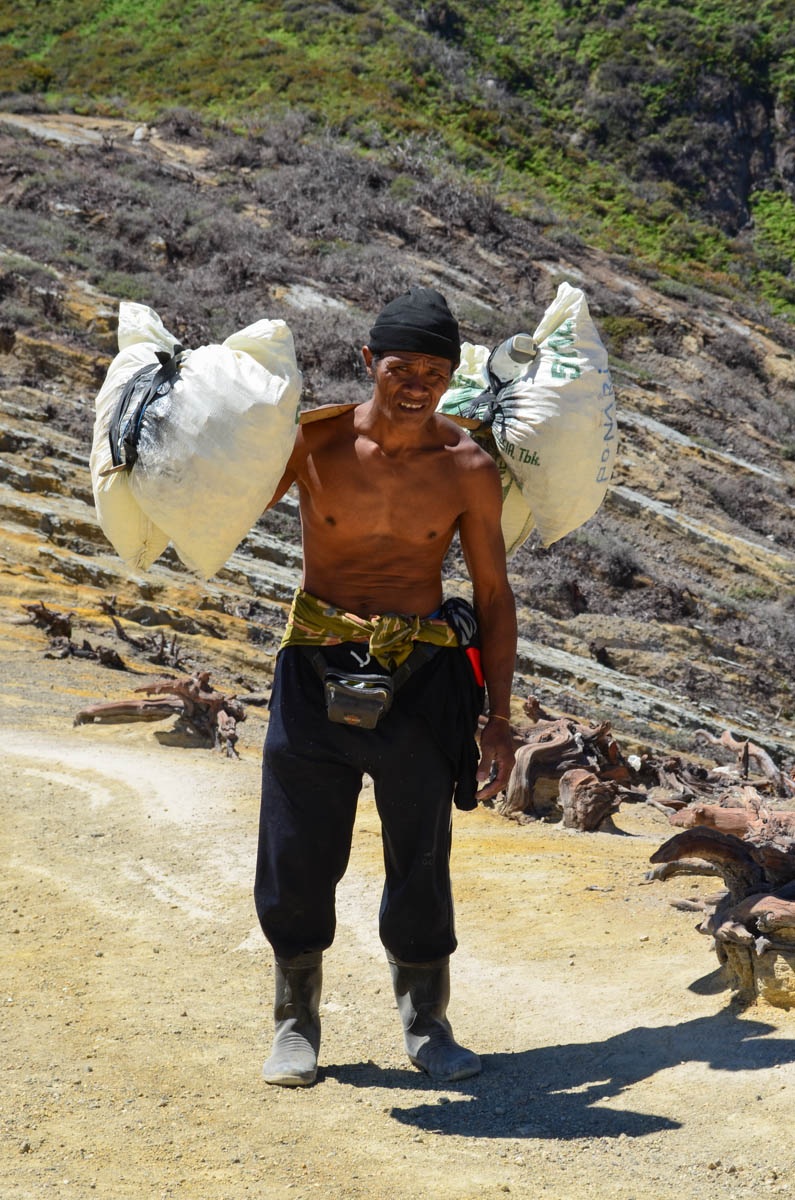


Now we could only stare while the miners, down at the bottom of the pit, sometimes invisible inside the cloud of noxious fumes, cooled down the molten sulfur with water and, once solid, chopped bricks of the precious material. And what awaited them next, once loaded, was not much to look forward to: a hike up 300 meters to the rim of the crater, followed by 3 km of descent to the village where they would sell the sulfur. For less than 0.10$ a kilogram.
And for most of them, this was their only source of income, their only hope of subsistence in life.
The silence was heavy as we walked around the rim of the crater, each of us gaping at the unbelievable — and yet daily — scene playing below, while wondering how we could have never known about such ways of life. I used to take pride in my education, before I realized that the “poor” people I met on my way were all teaching me instead, benignly smiling at my ignorance of the world. At my ignorance of the harshness of real life, of the reality that the majority of humans on this planet partake in.
Down at the small post at the bottom of the trail, over a dish of fried rice, a ranger told us how five workers had died once, simply because a bit of sulfur gas had decided to bubble out of the lake next to them.
I went on my way humbled.
Dear José,thanks for this extraordinary report. It is deeply authentic. The faces of your travel mates match to the feelings you express. Your fantastic fotos and your thougts combined educate us about the so different conditions humans have to face for everday’s struggle for their bread.
Cordially Claudio
Dear Claudio, thank you for this message! I truly hope I have been able to share a bit of what we learned that day, though it is certain nothing can equal the experience of seeing it with your own eyes. It was truly an unbelievable, otherworldly sight. I am glad you enjoyed this post!
José